Big Garden Birdwatch

Well, it’s the first day of February – rather cold, gray and dull although we do have snowdrops and the merest glimmer of colour from early primroses.

Yesterday was the RSPB Big Garden Birdwatch and we chose an hour in the morning when the garden is usually busy. Our final count gave us Goldfinches 8, Chaffinches 5, Lesser Redpoll 4, Coal Tit 1, Blackbirds 3, Robin 1, Great Tit 2, Blue Tit 4, Starling 1, Siskins 3, Longtailed Tit 1, Dunnock 2, Sparrow 2, Song Thrush 1, Nuthatch 1, Greenfinch 3, Carrion Crow 2, Magpie 1, Wren 1 and just as I put the pencil down, like a goal in extra time, the Sparrowhawk dashed through! It wasn’t really a good representation of our usual garden birds though, no Great Spotted Woodpecker, only three Blackbirds and hardly any Blue or Coal Tits compared to a normal morning. And why did the Crows decide to visit the garden? Not seen one so close to the house for months!

We are lucky to have the Lesser Redpolls and Siskins as such regular visitors. With the rear of the garden opening onto the rough bank which provides such a variety of habitats, eventually stretching to the River Severn and the Severn corridor, we draw in more than you might expect from a suburban garden.

Now, at three in the afternoon, the garden is a hive of activity … wait – a sudden whoosh, flashing wings, and there is not a bird to be seen! The Sparrowhawk making its presence felt! Yet, as on so many occasions, it leaves empty clawed. The smaller birds are daring to come out of hiding now, it’s going to be an early dusk so they need to stock up to keep themselves going through the long, cold night.
Ivy

This year has seen the ivy cloaking the trellis panels covered in flower and now, just when needed, berries. Ivy goes through four distinct cycles before starting to flower – although planted some years ago, it is only in the last couple of summers that it has really come into its own.

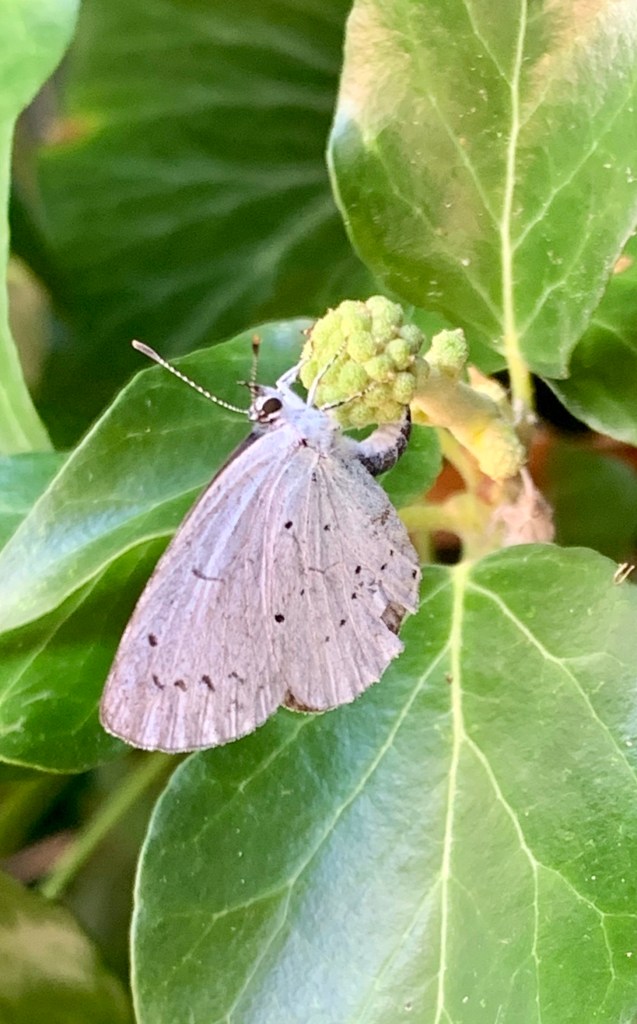
At the end of July last year, we watched second generation female Holly Blues lay their eggs on the tiny, still forming, berries and kept an eye on the caterpillars as they grew before crawling off to pupate.

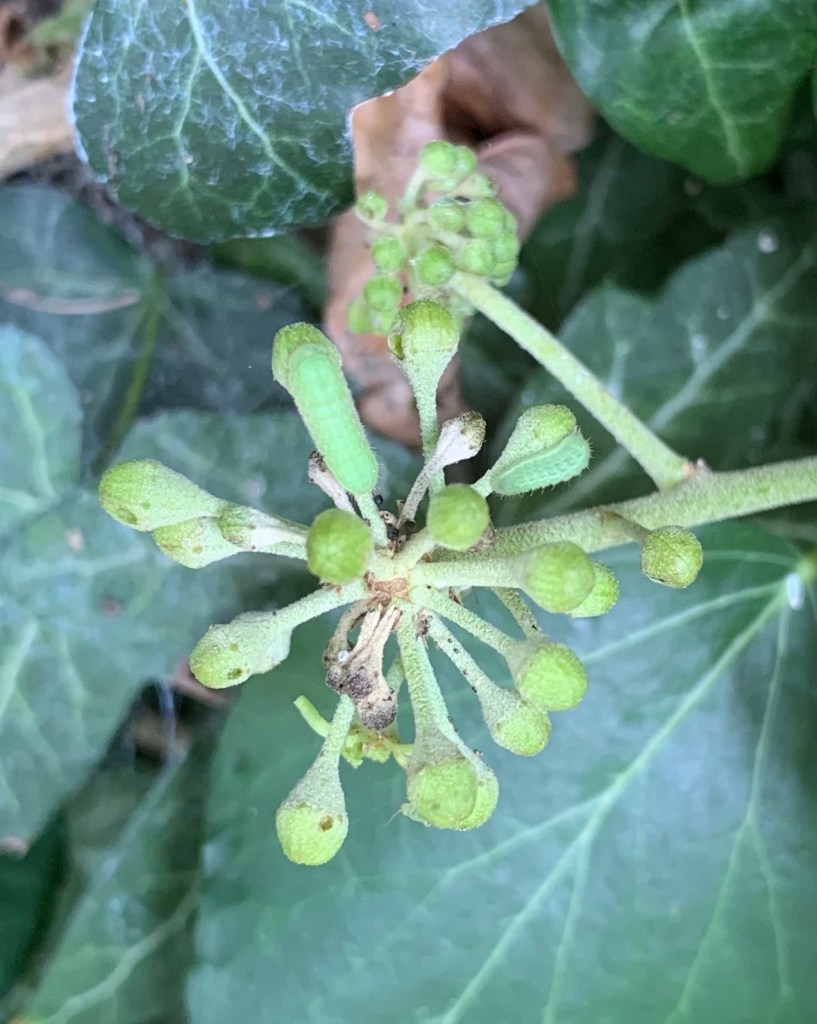
By the middle of August, the small green caterpillars had hatched but were quite hard to spot as they blended in beautifully with the forming fruits. Interestingly, the majority of eggs had been laid in a shaded area, out of full sun for most of the day.

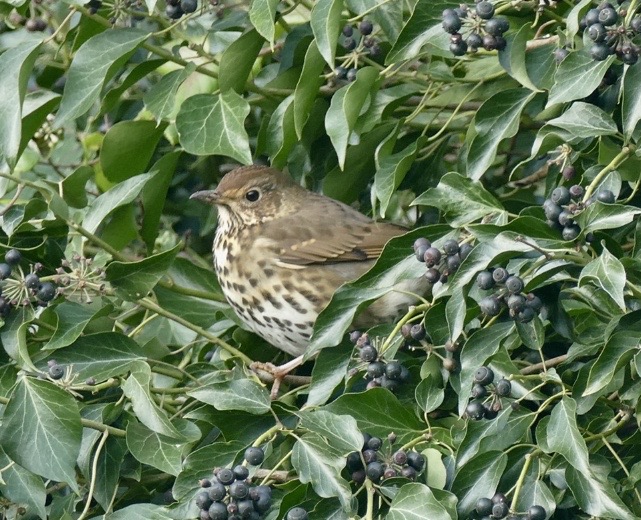
Now the remaining fruit is providing a bonus for the song thrush and blackbirds as they scour the ivy to find the fattest berries.

The Sparrowhawk!

She dashes through the garden as if following an invisible chicane, skirting the hawthorn and slicing past the bird feeders before heading up and over the copse. Empty clawed, as many of her raids end up, leaving the garden devoid of birds until the memory of her fades and the feeders are busy again.

This morning we have had the first female blackcap I’ve seen for a good while. Our growing flocks of lesser redpolls and siskins are beginning to come into something nearer their spring plumage, redpolls with pinky red chests, and the siskins bright yellows and green – a vibrant change from the more delicate blues and yellows of the tits.

Looking out now we have two nuthatches on the sunflower heart feeders and the song thrush is still happily tucking into the ivy berries. Chaffinches and dunnocks are doing their usual clean up under the containers.

Last night wasn’t quite so cold meaning there isn’t such a scrum for food, with less bickering between the smaller finches. It always seems that what they lack in size, they more than make up for in feistiness!

Snow is still lying in patches but has lost its grip on trees and bushes – the fox will still stand out as it makes its way down the bank behind us under the wary eye of the crows. They are the ‘top of the tree’ as far as the hierarchy of our birds is concerned, then come the magpies who boss the jays, and down to garden level with the greater spotted woodpecker and nuthatches ruling the feeders. That said, sometimes both of these are chased off by a noisy gaggle of starlings which will just descend and ignore any ‘rules’ or rights! The sparrowhaws and buzzards are outside of this ‘hierarchy’, free spirits wheeling over a much larger territory.

There is a small valley at the bottom of our garden, including a copse with its mix of aspen, willow, ash, hazel and the beautiful Italian poplars. There are rough banks covered by brambles where the dunnocks nest and a small open patch of grassland with green alkanet, marjoram and cow parsley. All these different areas are home to many insects, birds and mammals, and we are very lucky to share it with them!

The quietness of snow…

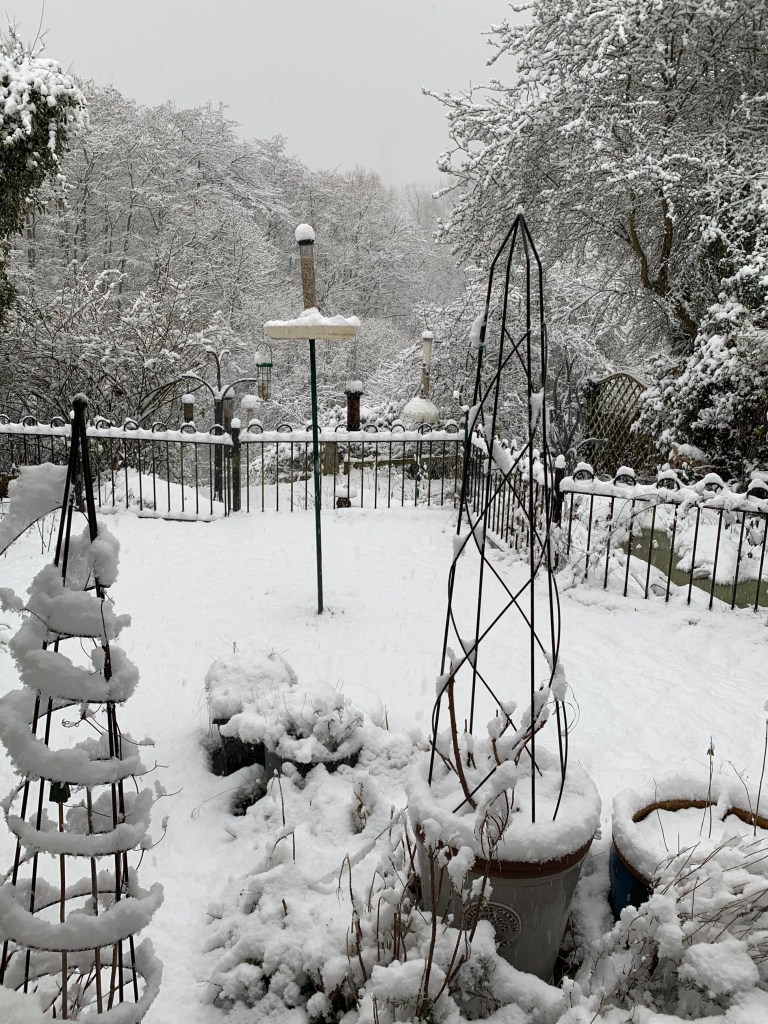
It is the 24th January and this morning, from about 7.30, we have had a heavy fall of snow. It is the quietness that encompasses everything after snow that gets forgotten, the sharp calls of birds the only sounds that break the silence in this newly changed landscape. And the stillness … which is disturbed by the flurry of a flock of goldfinches taking over a feeder. Then, as other birds begin their search for food after a cold night, the garden comes alive. A quick dash down the path to set out water, give the feeders a shake and scatter more food on the ground before the next ‘wave’ of birds arrives. We have had our full daily cast this morning apart from greater spotted woodpecker and wren, and not including our occasional visits from a male blackcap.

Now, at 11.00, the vital first feeds have been taken and we have just a few redpolls, sparrows, chaffinches, the odd blue tit, and blackbirds. We have had many more than usual this year, migrants from Scandinavia probably, dark birds with black beaks mixing happily with our usual birds.

A small flock of redwings has just flown over but not stopped to check out what’s on offer.

It is as it was – quiet and still and peaceful.

Here we are, mid-January, but now 2021!

And gosh, haven’t things changed since my last blog back in 2017. We’ve just been through the most gut-wrenching year with the Covid- 19 pandemic and the NHS is facing the worst situation in its history. Fingers crossed for a speedy rollout of vaccines and a good uptake throughout the population.

Now, to the window. The snow has gone and only the hard round ice blocks from the birds water tray are left, gradually melting as the temperature rises. Through the bare trees I can see a swan flying down the river and as the wind begins to swirl it unsettles the flock of pigeons in the poplar trees.

All day the feeders have been busy – first the blue and great tits, then a small flock of 8 goldfinches which commandeer an entire feeder and defend it against all comers. As the morning progresses the lesser redpolls and Siskins arrive, with greenfinches and nuthatches. Occasionally a robin will brave the melee, flying up to a feeder port and grabbing a sunflower heart or hovering for a second in front of the fat ball feeder – both are available on a tray feeder but seem less enticing than this central hub where all the other birds are feeding. Below, the dunnocks, sparrows, blackbirds and chaffinches clear up the untidy mess left by the penthouse visitors. This year we have had more blackbirds in the garden than I can ever remember, migrants from Scandinavia we presume – it is not unusual to have seven or eight in at the same time. Our rather bemused songthrush is very pleased with the abundance of ivy berries this year, which makes up for these strange visitors bossing him around. We’ve even had a single Redwing, attracted by the berries.

Today we have had the pair of Buzzards flying over the copse and landing in the big Italian poplar. During the gales at the end of October 2020 a large branch was broken off, unfortunately that branch was the usual spot for mating, which was an impressive sight. The female would sit in waiting while the male did some fancy flying high above her before diving down at speed to land on and mate with her. I think he must have shouted “Geronimo” or the Buzzard equivalent so she tightened her grip ready for his arrival! Hopefully one of the remaining branches is suitable and I’ll be able to watch the whole performance again this year.

Waxwings – but not in our garden!

2017 is definitely a Waxwing year, with records coming in thick and fast from around the country but the nearest we could find were in Borrington Road, Kidderminster.  Lovely to see them, however, even if they weren’t in the garden.  During the last big ‘invasion’, we did have a brief visit from a flock of 15 which descended onto the birdbath, landing all round the rim, before taking a drink and departing as quickly as they arrived.

The marsh tit was on the fat feeder again this morning but its visits are always short and hurried.  By time I’ve grabbed my camera it’s usually gone!

In the past week we have had visits from the badgers but not with the same regularity as we expect.  Some mornings this winter there have been nuts on the ground the following day instead of being cleared up quickly.  Both male and female muntjac have been in, taking advantage of the badgers absence.

The weather has been grey, misty and depressing, with just one bright sunny day to remind us that the sun is up there somewhere!

Starting the year.

After a few days indecision I am completing my first post on this blog.

Although snow was threatened, we had only a light dusting this morning, it’s still pretty cold though and the birds have been enthusiastically attacking the sunflower hearts put out for them.

The feeders are full and the fat balls are attracting plenty of long tailed tits as well as blue, great and coal tits.  We have an occasional visit from a marsh tit (last seen yesterday) but it only seems to be a single bird.  When we first moved to this estate they were regular visitors to our garden despite us living further into the estate.

There is constant activity around the feeders and on the ground beneath them.  I’m afraid some birds (especially the nuthatches!) are very fussy about which specific sunflower hearts they pick and discard any which don’t meet their exacting standards.  This provides scope for dunnocks, chaffinches, robins, blackbirds and the odd thrush to clear up – not to mention the merry band of squirrels which swarm over the garden!  Luckily we have discovered two good anti-squirrel feeders so at least they cannot eat everything.